80s Images Are Trending Again: Why Everyone Is Recreating the Retro Era
There is something strange about seeing a completely modern photograph suddenly look as though it came from an old family album.
By AceDROO Digital Services, Jaipur
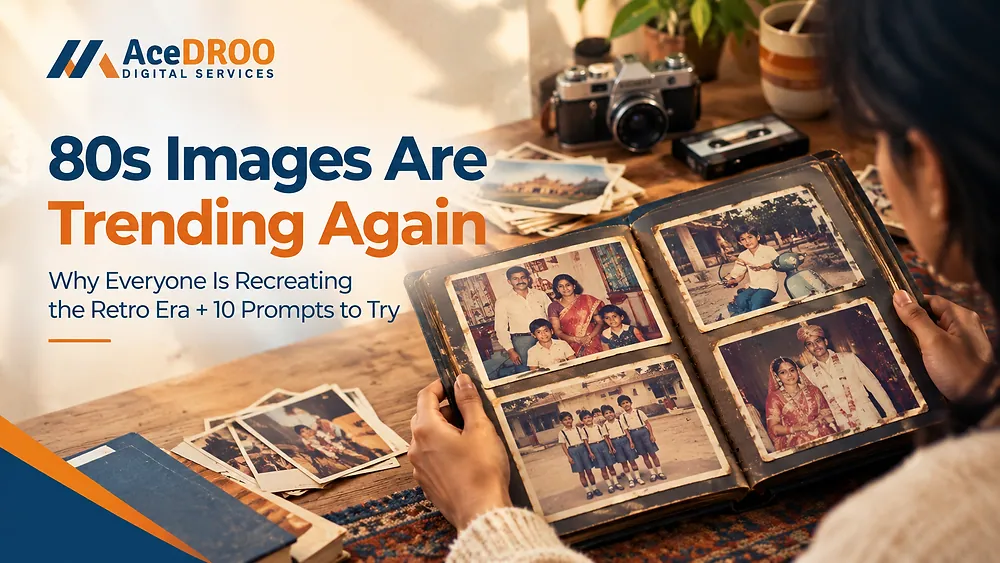
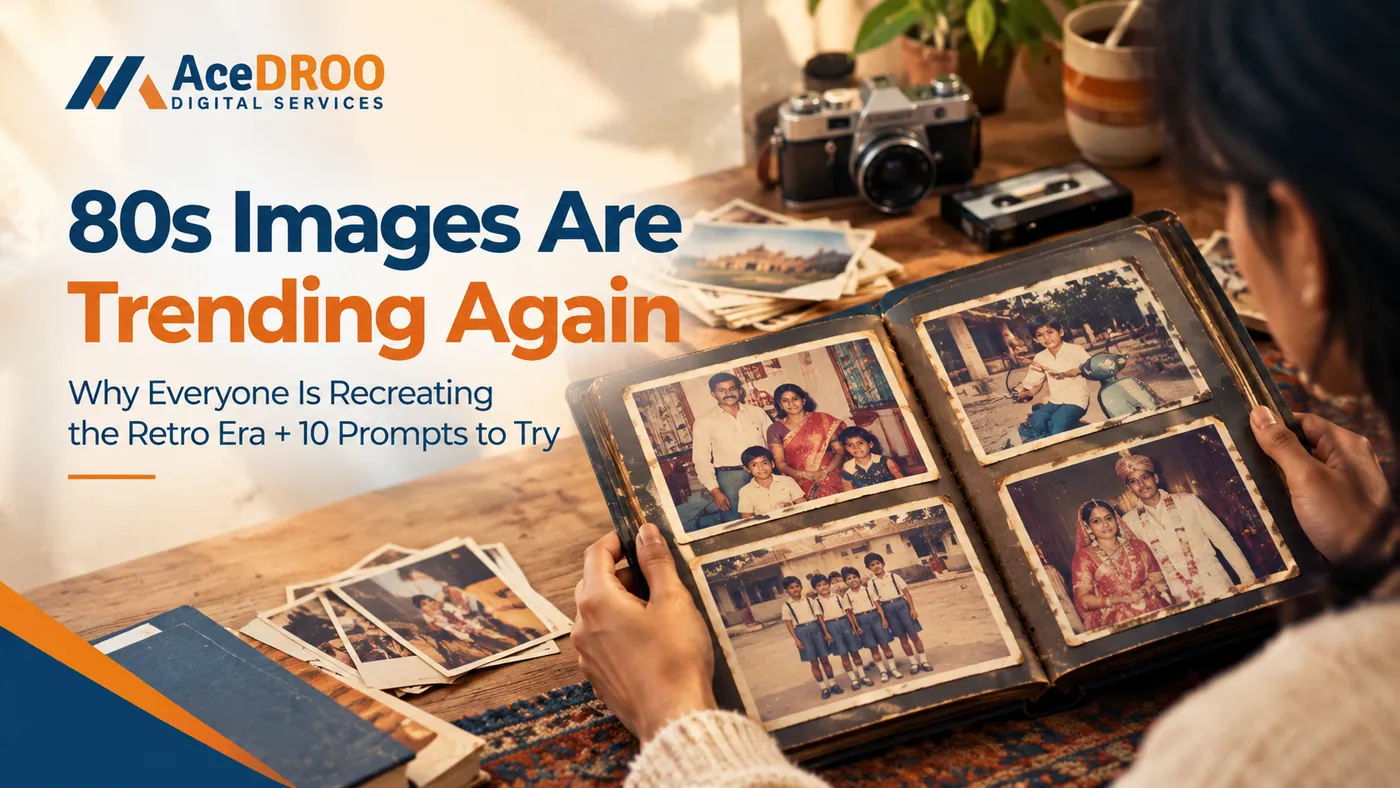
There is something strange about seeing a completely modern photograph suddenly look as though it came from an old family album.
That is exactly what is happening with the current 1980s photo trend. Across Instagram and X, people are turning present-day portraits into images inspired by the decade: bigger hairstyles, vintage clothing, dramatic poses, warm lighting, film-like grain, and the unmistakable feel of older photography. Recent Indian coverage has described the trend as a rapidly spreading social-media phenomenon, with celebrities and public figures also participating.
But the appeal is bigger than simply making a picture look old.
The 1980s had a recognizable visual personality. Photography was shaped by film, flash, available light, physical prints, period clothing, interiors, vehicles, signage, and the limitations of the cameras people actually used. Recreating that world today can therefore feel surprisingly personal.
For many people, the attraction is nostalgia. A childhood photograph, school memory, family portrait, wedding picture, or imagined version of yourself in another decade can become a piece of visual storytelling.
And modern image-generation tools make that experimentation much easier.
In this guide, we will look at why the 80s aesthetic is attracting attention, what makes a retro image convincing, how to write better trending 80s image prompts , and ten detailed prompts you can copy, customize, and experiment with.
Why Are 80s Images Trending Again?
The current retro-photo wave reflects several overlapping interests rather than one single cause.
- Nostalgia Is Highly Shareable
People naturally enjoy seeing familiar eras, styles, and memories represented visually.
An image can remind someone of childhood holidays, their parents' old photographs, school days, family gatherings, or the interiors of a home they remember. That emotional connection gives nostalgic content a reason to be shared beyond simply looking attractive.
- Retro Looks Stand Out
Modern social feeds are often filled with highly polished photography, carefully edited portraits, and consistent visual branding.
A slightly imperfect photograph can create contrast.
Film grain, direct flash, softer focus, unusual framing, faded colors, or realistic lighting can make an image feel less manufactured and more memorable.
- People Are Recreating Personal Memories
One of the most interesting parts of the trend is that it is not limited to generic vintage portraits.
People can recreate an imagined childhood, reinterpret an old family photograph, or place a present-day version of themselves into a period setting. The result is part photography experiment and part personal storytelling.
- Fashion and Culture Keep Returning
The 1980s continue to influence clothing, hairstyles, music-inspired visuals, graphic design, cinema aesthetics, and editorial photography.
That familiarity makes the decade easy to recognize even when the viewer was not alive during it.
- Image-Generation Tools Lower the Experimentation Barrier
Instead of manually sourcing a wardrobe, location, camera, lighting setup, props, and post-processing workflow, a user can describe the desired scene in detail.
Recent coverage of the trend specifically highlights users transforming contemporary photographs through detailed instructions about clothing, hairstyles, backgrounds, and photographic style.
Still, a prompt is not a time machine. Better instructions improve consistency, but historical accuracy still depends on the details you provide.
What Makes an Image Look Like It Was Actually Taken in the 1980s?
Creating a believable 80s image is not simply a matter of adding grain.
The strongest 80s style image prompts describe the entire visual environment.
Camera and Film Characteristics
Think in terms of analog photography rather than a digital image with a sepia effect.
Useful characteristics include:
- natural film grain
- slight softness
- subtle exposure inconsistencies
- direct flash
- mild color shifts
- realistic film texture
- occasional light leaks where appropriate
- slightly faded print colors
Do not make every image excessively grainy. Too much grain can make the result look deliberately stylized rather than genuinely photographed.
Clothing and Hairstyles
Clothing is one of the quickest ways to establish a period.
For Indian scenes, describe culturally appropriate clothing such as sarees, shirts, denim, dresses, traditional accessories, period hairstyles, and suitable footwear.
A modern outfit with an "80s filter" will usually feel less convincing than a complete period wardrobe.
Lighting
Lighting also matters.
Try describing:
- direct on-camera flash
- warm indoor tungsten light
- natural daylight
- practical household lighting
- mildly uneven exposure
Not every image needs dramatic lighting. Everyday photographs often look more believable than highly cinematic recreations.
Locations and Props
The environment should tell the same story as the subject.
Depending on the scene, that might include an old family home, school classroom, railway station, Indian street, wedding venue, scooter, vintage car, cassette player, CRT television, old furniture, or period signage.
Avoid adding random retro objects simply because they "look vintage."
Historical coherence matters more than quantity.
Composition
Think about how photographs were actually taken.
Useful compositions include family group portraits, studio portraits, candid snapshots, documentary-style street photography, and slightly imperfect framing.
The photograph does not always need to be perfectly centered or symmetrical.
A little imperfection can make it feel more believable.
How to Write a Good 80s Image Prompt?
A useful formula is:
Subject + Time Period + Location + Clothing + Lighting + Camera/Film Look + Composition + Mood + Details + Quality Control
Compare:
"Make this photo look 80s."
with:
"Create a realistic family photograph set in a middle-class Indian home in the mid-1980s, with period-appropriate cotton clothing, natural hairstyles, warm tungsten lighting, direct on-camera flash, slightly soft 35mm film rendering, subtle grain, faded print colors, imperfect framing, and authentic household details."
The second prompt gives the image generator a world to recreate.
That is the key.
A convincing 1980s image prompt describes the environment around the subject instead of relying on the word "retro" alone.
Ten Copy-Ready 80s Image Prompts
1. Authentic 1980s Family Portrait
This prompt creates a warm, believable family-album photograph rather than a polished contemporary studio image.
Customization Tip:
Replace the family size and home setting with details from your own memory, such as Jaipur, Delhi, Mumbai, or your hometown.
2. 1980s Indian Childhood Photograph
Perfect for recreating the feeling of an ordinary childhood day.
Customization Tip:
Add a specific childhood setting such as a Jaipur lane, schoolyard, family terrace, or neighborhood park.
3. 1980s Indian Wedding Photograph
A classic family-album style wedding scene with realistic period details.
Customization Tip:
Specify the region, wedding ritual, venue type, and family relationships for a more personal result.
4. 1980s Bollywood-Inspired Portrait
This prompt captures the visual language of Indian cinema without copying a particular film or celebrity.
Customization Tip:
Choose "studio portrait," "film-magazine portrait," or "theatrical publicity photograph" as the composition direction.
5. 1980s Indian Street Photography
The environment is the star of this prompt.
Customization Tip:
Replace "Indian city" with Jaipur, Delhi, Kolkata, Mumbai, Ahmedabad, or another specific location.
6. 1980s School Photograph
Ideal for a nostalgic classroom or school-memory scene.
Customization Tip:
Add the school type, city, season, and approximate year for stronger historical consistency.
7. 1980s Fashion Portrait
Use this when you want the retro aesthetic to be fashion-led.
Customization Tip:
Specify the fashion direction - Indian casualwear, wedding fashion, officewear, denim, or studio glamour.
8. Recreate an Old Photograph in the 1980s
Use this when transforming a current photograph while keeping the person recognizable.
Customization Tip:
Add a specific year such as 1983, 1986, or 1989 and describe the original photo's relationship - family portrait, school photo, wedding, vacation, or street snapshot.
9. 1980s Travel Photograph
A vacation snapshot often becomes more convincing when it feels ordinary rather than cinematic.
Customization Tip:
Pair the setting with a season, such as "Jaipur winter morning" or "hill station monsoon afternoon."
10. "A Photo From My Childhood"
This is designed around emotion and everyday authenticity.
Customization Tip:
Think of one tiny real-world memory sitting on a terrace, returning from school, visiting grandparents, playing outside, or standing beside a family scooter and build the prompt around it.
How to Customize These 80s Prompts for Your Own Photos?
The easiest way to personalize an 80s photo prompt is to replace the variables rather than rewriting everything.
Try combinations such as:
Jaipur + 1980s family home + evening + warm tungsten light
1980s schoolyard + monsoon season + candid family-album photograph
Railway journey + Indian family + early morning daylight + 35mm film
Wedding courtyard + Rajasthan + direct flash + slightly faded print colors
Childhood terrace + summer evening + ordinary family snapshot
A useful rule is to choose one detail from each category:
where, when, who, what they are wearing, how the scene is lit, and how the photograph was captured.
Also remember to use photographs you own or have permission to transform when working with real people.
Common Mistakes When Creating 80s-Style Images
The most common mistake is simply writing "make it look 80s."
Other problems include using modern clothes, adding random vintage props, making grain excessive, turning every image orange or brown, over-smoothing skin, accidentally introducing smartphones and modern technology, or altering someone's face during a photo transformation.
Another common issue is making the image resemble a movie poster instead of a photograph.
The goal is not to maximize retro effects.
Authenticity comes from consistency, not from adding more retro effects.
Are 80s Image Prompts Useful for Social Media?
Absolutely, provided the visual idea supports the content.
Retro imagery can work for Instagram posts and Reels, nostalgia-based storytelling, personal memory posts, fashion concepts, creative advertising, blog illustrations, family stories, and brand campaigns.
For creators, it can become a recognizable visual series. For businesses, it can support anniversary campaigns, heritage storytelling, retro product concepts, or brand-history content.
The important distinction is purpose.
A business should not use an 80s aesthetic simply because the trend is receiving attention. The visual should communicate something: heritage, memory, personality, a product story, or a cultural connection.
How Businesses Can Use Retro Visual Trends Without Looking Outdated?
Nostalgia becomes more effective when it is connected to a real brand idea.
A restaurant could reinterpret an old family recipe as a vintage-inspired visual story.
A fashion brand could connect current collections with historical styling.
A local business could create a "then and now" story about its neighborhood.
A legacy company could use old-inspired visuals for an anniversary campaign.
A brand can also combine archival-looking imagery with modern typography and clean layouts, allowing the nostalgia to support the message without making the entire identity look dated.
This is the difference between using nostalgia strategically and copying a trend without a reason .
How Can AceDROO Digital Services Help?
Retro content is one example of how creative direction and modern image-generation workflows can work together.
AceDROO Digital Services works across social media content, graphic design, website content, digital marketing strategy, creative content concepts, and image-generation-assisted workflows.
The approach is simple:
Human creative direction + modern tools + thoughtful execution.
Want to explore a retro-inspired content concept for your brand? Get in touch with AceDROO Digital Services for a free consultation.
Frequently Asked Questions
What are 80s image prompts?
80s image prompts are detailed instructions used to create or transform images so they resemble photography associated with the 1980s. Instead of only requesting a "retro look," a useful prompt specifies clothing, hairstyles, location, lighting, camera characteristics, film texture, composition, props, and the overall mood.
How do I create an 80s-style photo?
Describe the scene as though you are recreating a photograph from the decade. Include the subject, location, clothing, hairstyle, lighting, camera or film appearance, composition, and period-specific objects. Avoid relying only on words such as "vintage" or "retro," because they do not define the complete visual context.
How can I make an AI-generated image look genuinely 1980s?
Build consistency into the prompt. Clothing, architecture, vehicles, furniture, lighting, camera characteristics, and hairstyles should belong to the same era. Add subtle film grain and softness rather than excessive effects. A believable 80s image should look like a photograph from its period, not a modern digital image with a filter.
Can I turn my current photo into an 80s-style photograph?
Yes. Image-generation tools can transform a contemporary photograph by changing elements such as clothing, hairstyle, surroundings, lighting, and photographic rendering. For personal photographs, explicitly instruct the tool to preserve the person's identity and avoid changing their facial characteristics.
How do I preserve someone's face when recreating an old photo?
State clearly that facial identity is the top priority. Ask the image tool to preserve facial structure, face shape, skin tone, age, body proportions, natural expression, and recognizability. Also tell it not to reshape, beautify, de-age, age, or replace the face.
What details make an 80s photo look authentic?
Authenticity comes from a combination of details rather than one effect. Period clothing, hairstyles, interiors, vehicles, lighting, analog camera characteristics, film texture, composition, and everyday objects all contribute. Slight imperfections can also help, but excessive grain or artificial aging can make the image less convincing.
Can I create an 80s-style Indian photograph?
Yes. An Indian 80s image can be made more convincing by specifying culturally appropriate clothing, homes, streets, wedding traditions, school environments, scooters, vehicles, architecture, signage, and everyday objects. Location matters too, because an 80s photograph in Jaipur may have a very different visual environment from one in Mumbai or Kolkata.
Can businesses use 80s-style images for marketing?
Yes, especially for nostalgia campaigns, anniversaries, heritage storytelling, retro product concepts, brand-history content, and social-media campaigns. The strongest executions connect the retro treatment to a meaningful brand message instead of using the aesthetic only because it is trending.
Conclusion
The appeal of 1980s photography is not simply that the decade looked old. It had a distinctive visual character shaped by film, clothing, hairstyles, interiors, lighting, cameras, and everyday life.
That is why detailed 80s image prompts work better than simply asking for a retro filter.
When you describe the world around the subject and keep that world historically consistent, the result can feel much more believable.
For personal photographs, identity should come first and transformation second. For creative projects, experimentation is part of the fun.
The current wave of 1980s recreations shows how nostalgia can become a powerful visual language. Used thoughtfully, it can turn an ordinary photograph into a story about memory, culture, personality, or a different version of time.
And sometimes, that is all a good photograph needs: a feeling that you have seen it before.
Written by the AceDROO team, Jaipur
All articles